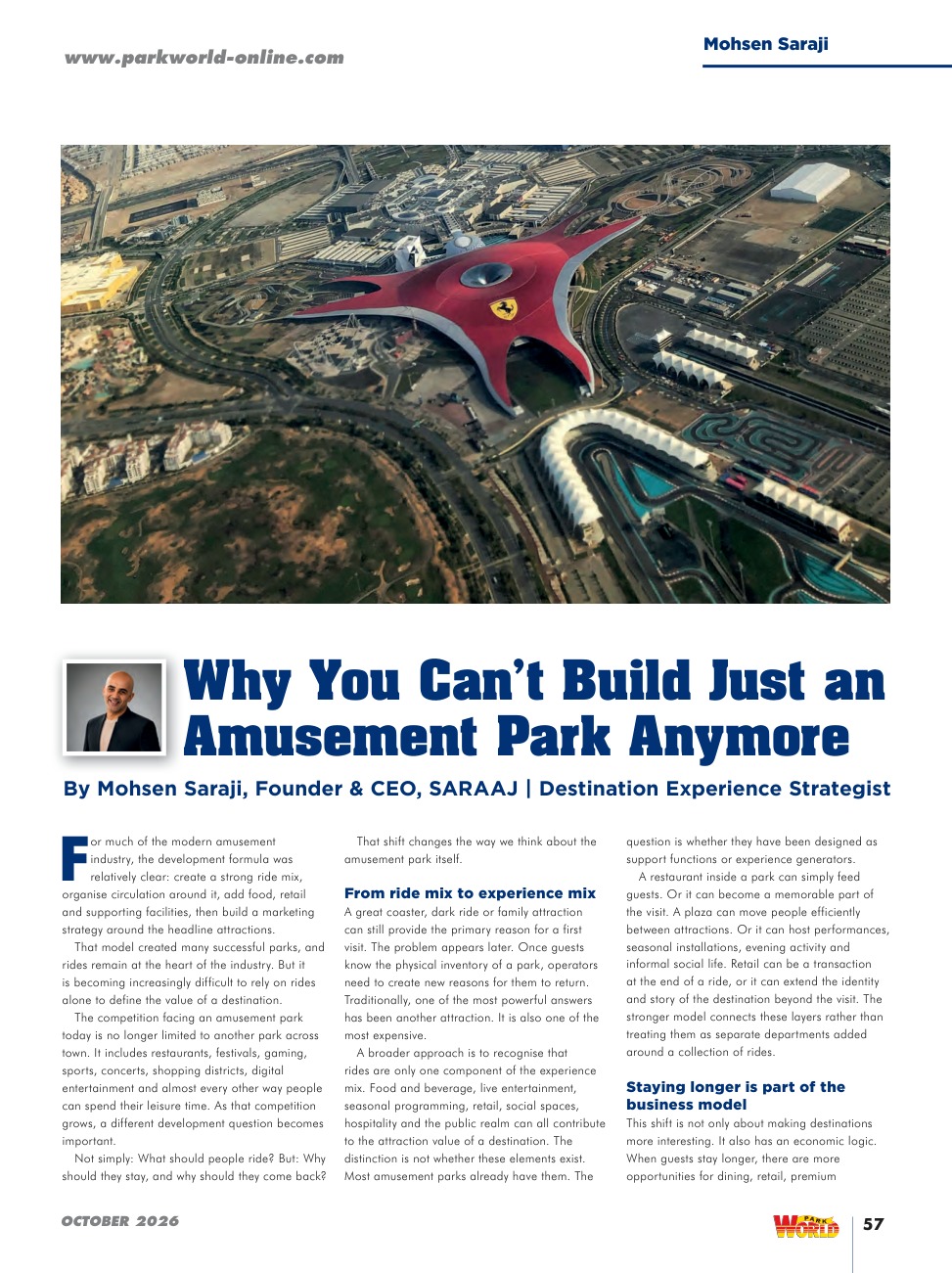
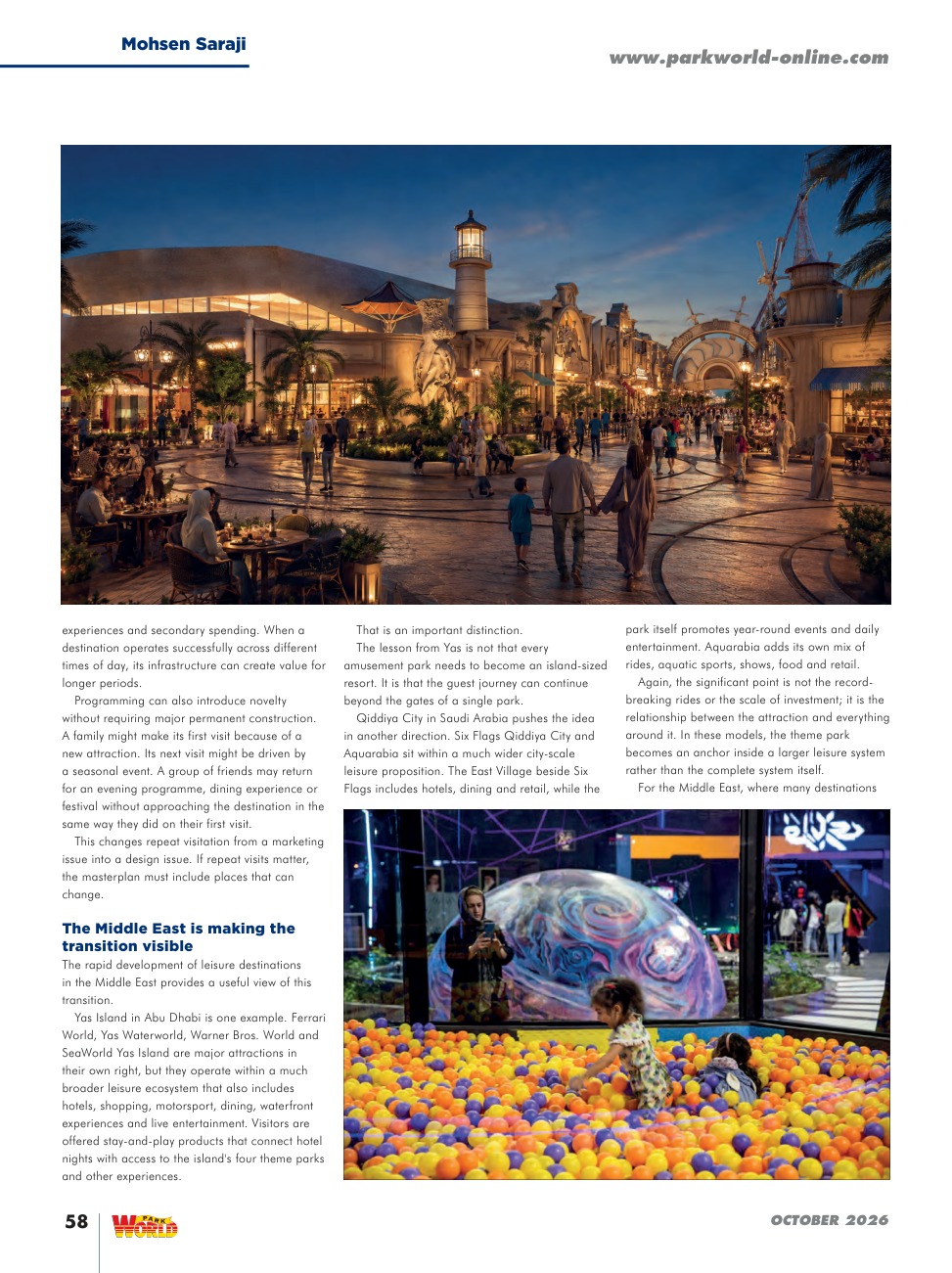
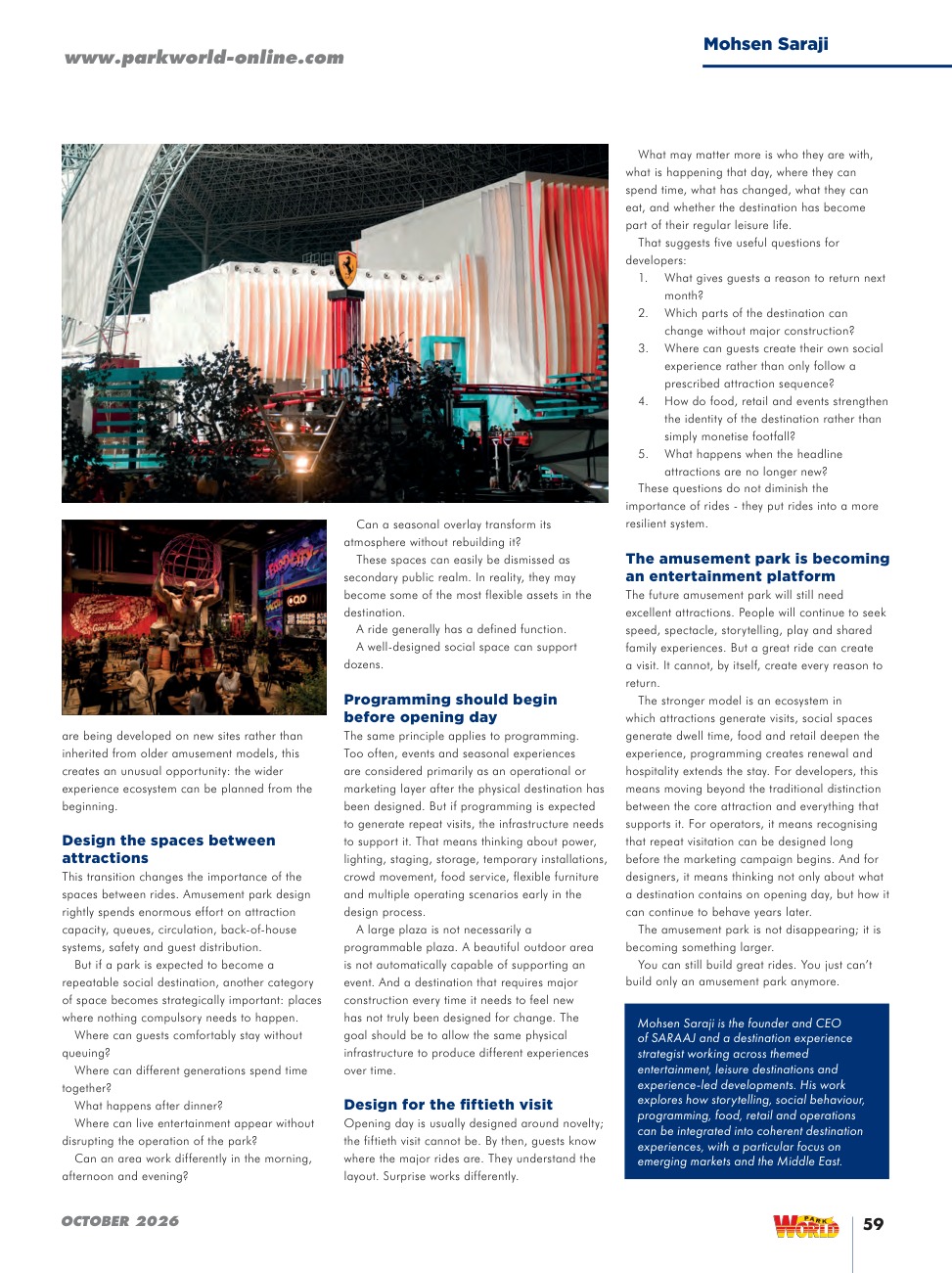
×

SEARCH



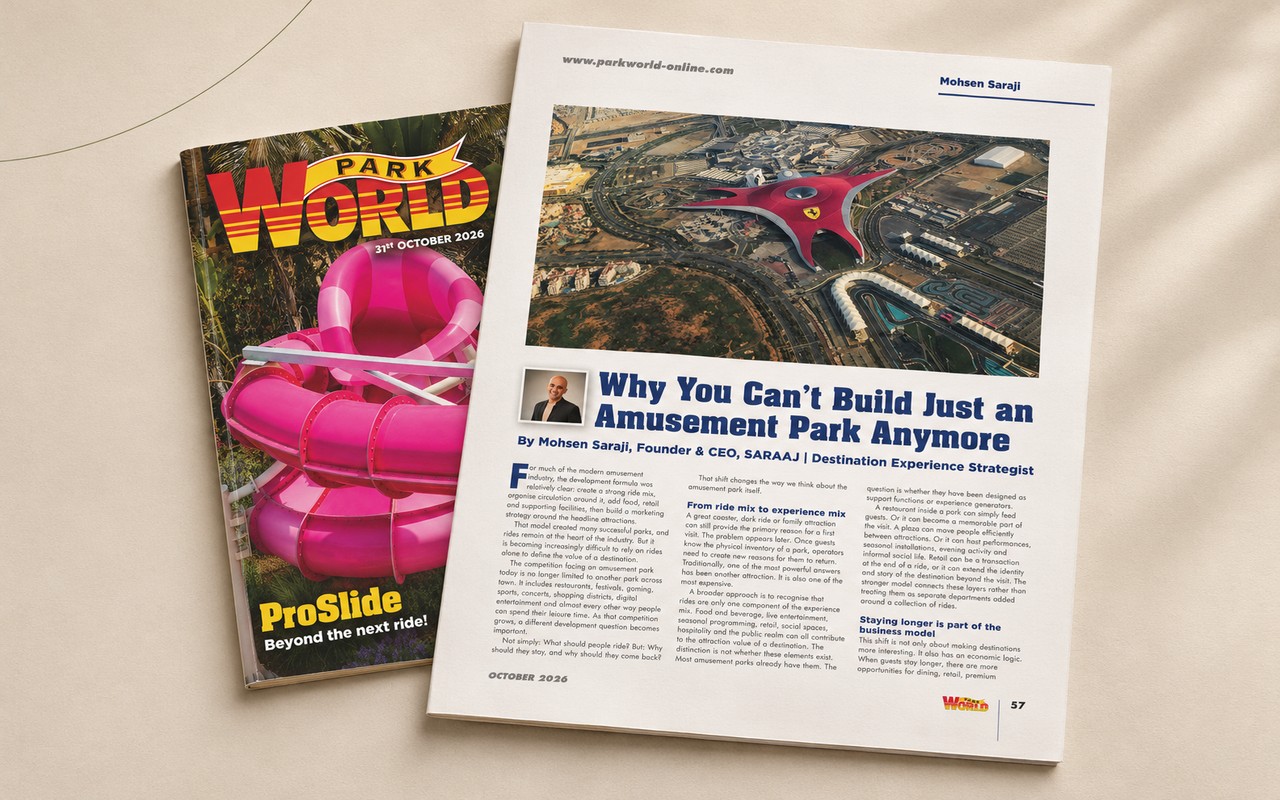
Originally published in Park World, October 2026, pages 57–59 of the digital edition. Park World is a UK-based specialist publication covering amusement parks, themed attractions and the international leisure industry.
By Mohsen Saraji, Founder & CEO, SARAAJ | Destination Experience Strategist
For much of the modern amusement industry, the development formula was relatively clear: create a strong ride mix, organise circulation around it, add food, retail and supporting facilities, then build a marketing strategy around the headline attractions. That model created many successful parks, and rides remain at the heart of the industry. But it is becoming increasingly difficult to rely on rides alone to define the value of a destination.
The competition facing an amusement park today is no longer limited to another park across town. It includes restaurants, festivals, gaming, sports, concerts, shopping districts, digital entertainment and almost every other way people can spend their leisure time. As that competition grows, a different development question becomes important.
Not simply: What should people ride? But: Why should they stay, and why should they come back? That shift changes the way we think about the amusement park itself.
A great coaster, dark ride or family attraction can still provide the primary reason for a first visit. The problem appears later. Once guests know the physical inventory of a park, operators need to create new reasons for them to return. Traditionally, one of the most powerful answers has been another attraction. It is also one of the most expensive.
A broader approach is to recognise that rides are only one component of the experience mix. Food and beverage, live entertainment, seasonal programming, retail, social spaces, hospitality and the public realm can all contribute to the attraction value of a destination. The distinction is not whether these elements exist. Most amusement parks already have them. The question is whether they have been designed as support functions or experience generators.
A restaurant inside a park can simply feed guests. Or it can become a memorable part of the visit. A plaza can move people efficiently between attractions. Or it can host performances, seasonal installations, evening activity and informal social life. Retail can be a transaction at the end of a ride, or it can extend the identity and story of the destination beyond the visit.
The stronger model connects these layers rather than treating them as separate departments added around a collection of rides.
This shift is not only about making destinations more interesting. It also has an economic logic.
When guests stay longer, there are more opportunities for dining, retail, premium experiences and secondary spending. When a destination operates successfully across different times of day, its infrastructure can create value for longer periods.
Programming can also introduce novelty without requiring major permanent construction. A family might make its first visit because of a new attraction. Its next visit might be driven by a seasonal event. A group of friends may return for an evening programme, dining experience or festival without approaching the destination in the same way they did on their first visit.
This changes repeat visitation from a marketing issue into a design issue. If repeat visits matter, the masterplan must include places that can change.
The rapid development of leisure destinations in the Middle East provides a useful view of this transition.
Yas Island in Abu Dhabi is one example. Ferrari World, Yas Waterworld, Warner Bros. World and SeaWorld Yas Island are major attractions in their own right, but they operate within a much broader leisure ecosystem that also includes hotels, shopping, motorsport, dining, waterfront experiences and live entertainment. Visitors are offered stay-and-play products that connect hotel nights with access to the island's four theme parks and other experiences.
That is an important distinction. The lesson from Yas is not that every amusement park needs to become an island-sized resort. It is that the guest journey can continue beyond the gates of a single park.
Qiddiya City in Saudi Arabia pushes the idea in another direction. Six Flags Qiddiya City and Aquarabia sit within a much wider city-scale leisure proposition. The East Village beside Six Flags includes hotels, dining and retail, while the park itself promotes year-round events and daily entertainment. Aquarabia adds its own mix of rides, aquatic sports, shows, food and retail.
Again, the significant point is not the record-breaking rides or the scale of investment; it is the relationship between the attraction and everything around it. In these models, the theme park becomes an anchor inside a larger leisure system rather than the complete system itself.
For the Middle East, where many destinations are being developed on new sites rather than inherited from older amusement models, this creates an unusual opportunity: the wider experience ecosystem can be planned from the beginning.
This transition changes the importance of the spaces between rides. Amusement park design rightly spends enormous effort on attraction capacity, queues, circulation, back-of-house systems, safety and guest distribution.
But if a park is expected to become a repeatable social destination, another category of space becomes strategically important: places where nothing compulsory needs to happen.
Where can guests comfortably stay without queuing? Where can different generations spend time together? What happens after dinner? Where can live entertainment appear without disrupting the operation of the park? Can an area work differently in the morning, afternoon and evening? Can a seasonal overlay transform its atmosphere without rebuilding it?
These spaces can easily be dismissed as secondary public realm. In reality, they may become some of the most flexible assets in the destination.
A ride generally has a defined function. A well-designed social space can support dozens.
The same principle applies to programming. Too often, events and seasonal experiences are considered primarily as an operational or marketing layer after the physical destination has been designed. But if programming is expected to generate repeat visits, the infrastructure needs to support it.
That means thinking about power, lighting, staging, storage, temporary installations, crowd movement, food service, flexible furniture and multiple operating scenarios early in the design process.
A large plaza is not necessarily a programmable plaza. A beautiful outdoor area is not automatically capable of supporting an event. And a destination that requires major construction every time it needs to feel new has not truly been designed for change. The goal should be to allow the same physical infrastructure to produce different experiences over time.
Opening day is usually designed around novelty; the fiftieth visit cannot be. By then, guests know where the major rides are. They understand the layout. Surprise works differently.
What may matter more is who they are with, what is happening that day, where they can spend time, what has changed, what they can eat, and whether the destination has become part of their regular leisure life.
That suggests five useful questions for developers:
These questions do not diminish the importance of rides - they put rides into a more resilient system.
The future amusement park will still need excellent attractions. People will continue to seek speed, spectacle, storytelling, play and shared family experiences. But a great ride can create a visit. It cannot, by itself, create every reason to return.
The stronger model is an ecosystem in which attractions generate visits, social spaces generate dwell time, food and retail deepen the experience, programming creates renewal and hospitality extends the stay. For developers, this means moving beyond the traditional distinction between the core attraction and everything that supports it. For operators, it means recognising that repeat visitation can be designed long before the marketing campaign begins.
And for designers, it means thinking not only about what a destination contains on opening day, but how it can continue to behave years later.
The amusement park is not disappearing; it is becoming something larger.
You can still build great rides. You just can’t build only an amusement park anymore.
About the author: Mohsen Saraji is the founder and CEO of SARAAJ and a destination experience strategist working across themed entertainment, leisure destinations and experience-led developments. His work explores how storytelling, social behaviour, programming, food, retail and operations can be integrated into coherent destination experiences, with a particular focus on emerging markets and the Middle East.
The three article pages from Park World’s October 2026 issue, in publication order. Select any page to view it at full size.